 OPTIMUS DISTRIBUTOR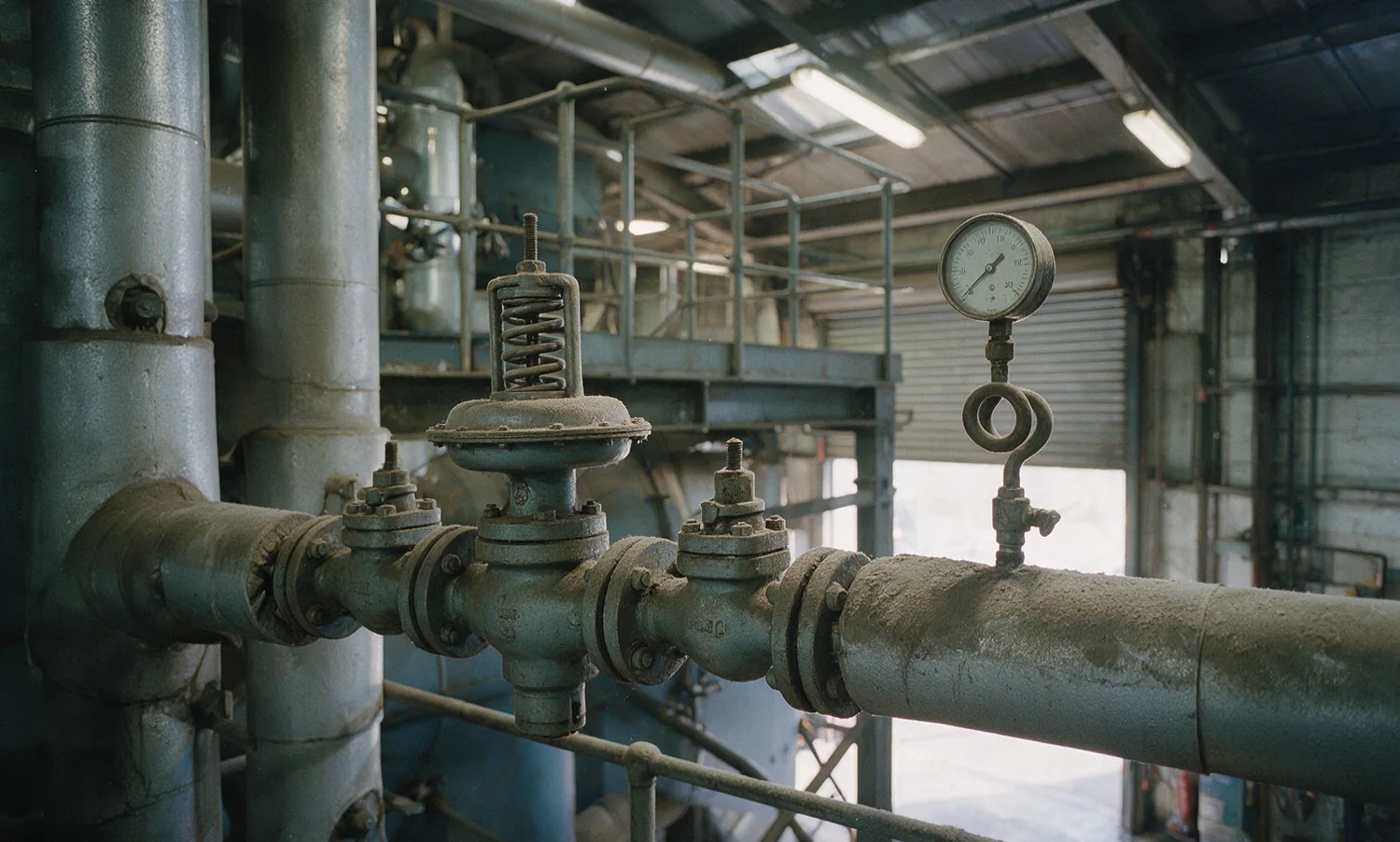
01What a PRV does, in one paragraph
A pressure reducing valve holds a set downstream pressure on its own, with no external power: a spring or pilot senses the outlet, and the valve throttles itself to keep that outlet at the set point while the upstream side and the demand both move around. It is a protection and regulation device, not an isolation valve — where it sits in the wider selection landscape is mapped in choosing the right industrial valve. Sizing one is a small discipline of its own, and getting it wrong in either direction costs money for years.
02The data you need before sizing anything
Every PRV selection stands on three numbers, and the third is the one that gets fudged. Collect them from the system, not from hopes:
| Input | What to establish | The usual mistake |
|---|---|---|
| Inlet pressure P1 | The real upstream pressure at the valve, including its low extreme — not the boiler or pump nameplate | Using nameplate pressure; the line loses pressure on the way, and the valve is selected against a fiction |
| Outlet pressure P2 | The set pressure the downstream equipment actually needs, and its tolerance | Setting P2 "a bit higher to be safe", which re-imports the overpressure the PRV exists to remove |
| Flow range | Peak demand AND normal/minimum demand — the full turndown the valve must cover | Sizing on peak alone, then adding a margin on top; the valve then idles nearly shut all year |
| Fluid condition | Steam (saturated or superheated) or water, temperature, and cleanliness | Ignoring dirt — debris is a leading cause of a PRV that will not hold its set point |
One derived figure matters as much as the three inputs: the pressure reduction ratio P1 to P2. Steam service with a large ratio may need two valves in series — a single stage asked to cut pressure too far runs noisy, wears fast and controls badly. Check the maker's stated limit for the model rather than assuming one figure fits all.
03Sizing steps: steam service
- Fix P1 at the valve inlet — measured where possible, and taken at its lowest credible value, since capacity falls with inlet pressure.
- Fix P2 from the downstream equipment's requirement, and confirm the P1→P2 ratio is within the model's single-stage limit; if not, plan two stages.
- Establish peak steam demand in kg/h from the connected equipment, and the minimum realistic demand — the turndown the valve must control across.
- Enter the maker's capacity chart with P1, P2 and peak flow; shortlist the valve whose rated capacity covers the peak with modest headroom, never the next size "for safety".
- Check the seat can control at minimum flow — if one valve cannot span the turndown, fit two PRVs in parallel (a small valve for nights, a larger one for peak).
- Confirm body rating and materials against P1 and saturation temperature on the pressure–temperature chart, and confirm against the current edition of the governing standard on your purchase order.
Note what is absent: pipe size. A PRV is sized from capacity charts, and it is routinely one or two sizes smaller than the line it sits in — matched to the pipe with reducers. Buying a PRV to fit the flange is the fastest way to oversize it.
04Sizing steps: water service
- Fix P1, P2 and the design flow range, exactly as for steam — for buildings, peak simultaneous demand, not the sum of every outlet.
- Select from the maker's flow charts so the valve passes peak flow at an acceptable pressure drop and velocity — liquid service punishes high velocity with noise, erosion and cavitation.
- Check the cavitation margin where the reduction is deep: a large P1→P2 cut at low outlet pressure can flash and collapse bubbles across the seat, eating it. Stage the reduction if the chart says so.
- Verify behaviour at minimum flow — a PRV feeding a nearly closed system should still hold set point without chatter, and dead-end (no-flow) service needs a valve rated for tight shutoff.
- Confirm body and trim materials for the water quality and temperature, then the connection standard and face-to-face against the piping spec.
05Why an oversized PRV hunts
Oversizing feels safe and is the opposite. A valve far bigger than the duty spends its life barely off its seat, where a tiny stem movement produces a large change in flow. The control loop overshoots, the pressure swings, the valve corrects back — and the system settles into a standing oscillation: hunting. The seat and plug wear where they touch, the downstream gauge never rests, and within a season the valve neither holds set point nor shuts drop-tight. The same money spent on the correct smaller valve buys years of quiet regulation. This failure mode is the PRV chapter of a larger story we tell in why the cheapest valve usually costs the most — wrong-sized is just another way of buying wrong.
06Installation essentials
A correctly sized PRV still fails early in a badly dressed station. The set that protects it:
- Strainer upstream — debris under the seat is the most common reason a PRV "won't hold pressure"; on steam, a separator and trap set upstream keeps condensate slugs away too.
- Pressure gauges on both sides — without P1 and P2 visible, commissioning is guesswork and troubleshooting is folklore.
- Isolation valves and a bypass — so the PRV can be serviced without shutting the process down; keep the bypass locked closed in normal running.
- A safety valve downstream where downstream equipment cannot tolerate full upstream pressure — the PRV regulates, it does not certify protection.
- Straight pipe per the maker's manual either side, and the sensing line (on pilot types) connected where the manual says, not where it was convenient.
07Check the selection before it becomes an order
Our PRV principal is Yoshitake of Japan — regulating valves, PRVs and steam traps — and the ranges we stock, with the supporting strainers and traps, are on the Yoshitake pressure reducing valves and steam traps page. Send us the three numbers and the fluid condition and we run the selection against the current Yoshitake charts before quoting; where the numbers are uncertain, we sit down with your engineers to make sure you get the right solution rather than the biggest one. Price, lead time and stock come back on the first reply — and if your steam station has a slamming check valve too, read our water hammer guide while you are here.