 OPTIMUS DISTRIBUTOR
01Three patterns, three jobs
Ask three engineers which valve to fit and you will often get three answers, because each of them is silently answering a different question. Gate, globe and ball are not three grades of the same thing — they are three mechanisms built around three different jobs. The gate lifts a wedge or slab clear of the bore so the line runs as if the valve were not there. The globe pushes a disc down onto a horizontal seat so the opening can be metered. The ball spins a drilled sphere through ninety degrees so the line goes from shut to open in one movement of the wrist.
Once you see the mechanism, the trade-offs stop being opinions. Everything each pattern is good at, and everything it is bad at, follows from how it gets out of the flow's way — or refuses to. That is the whole of this article, and it sits underneath the wider selection path in our pillar guide, choosing the right industrial valve: duty first, budget second.
02Gate: full-bore isolation, and nothing else
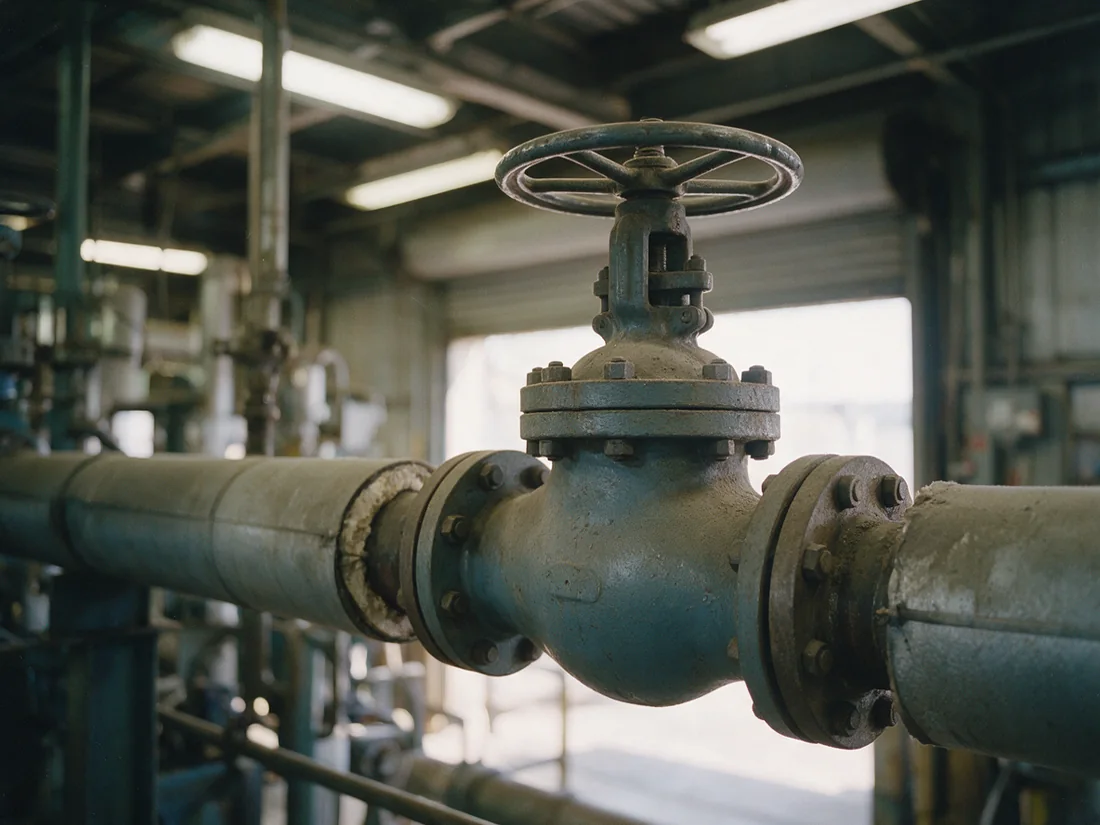
A gate valve's wedge retracts fully into the bonnet, leaving a straight, unobstructed bore. The pressure drop across a fully open gate is close to that of an equivalent length of pipe, which is why gates dominate long transmission runs, pump suction lines, tank isolation and any duty where head is precious. The straight bore also tolerates viscous and lightly solid-bearing fluids that would clog a tortuous body, and rising-stem outside-screw-and-yoke designs give the operator a visible, greasable indication of position.
What it trades away is everything to do with movement. A gate is multi-turn: closing a large one takes many turns of the handwheel or a sizeable multi-turn actuator, so it is slow by design. Held part-open, the flow accelerates across the narrow gap between disc and seat and wire-draws the sealing faces, while the disc itself can chatter in the stream. A gate is an on/off device that happens to pass through the middle — not a control device that happens to close.
03Globe: the pattern that exists to throttle
A globe valve turns the flow through an S-shaped path and seats a disc perpendicular to it. That geometry is deliberately obstructive: even wide open, a globe imposes a real pressure drop, and that is the price of what it buys. Because the disc approaches the seat along its own axis, the opening changes smoothly and predictably with stem travel, so the valve can hold a flow rate rather than merely permit one. Seat contact is face-to-face rather than sliding, so throttling does not scrub the sealing surfaces the way it does in a gate.
The consequences are worth stating plainly. The permanent head loss has to be paid for in pump energy for the life of the plant. Flow direction usually matters — most globes are installed to a specified orientation — and the actuator has to work against the line pressure acting on the disc, which means more thrust and a larger drive than a quarter-turn valve of the same size. In exchange you get regulation, good shutoff and a body that can usually be reseated in line. Where the duty is genuinely modulating in a building services loop, the modern answer is often not a globe at all but a pressure independent control valve.
04Ball: quarter-turn speed and easy automation
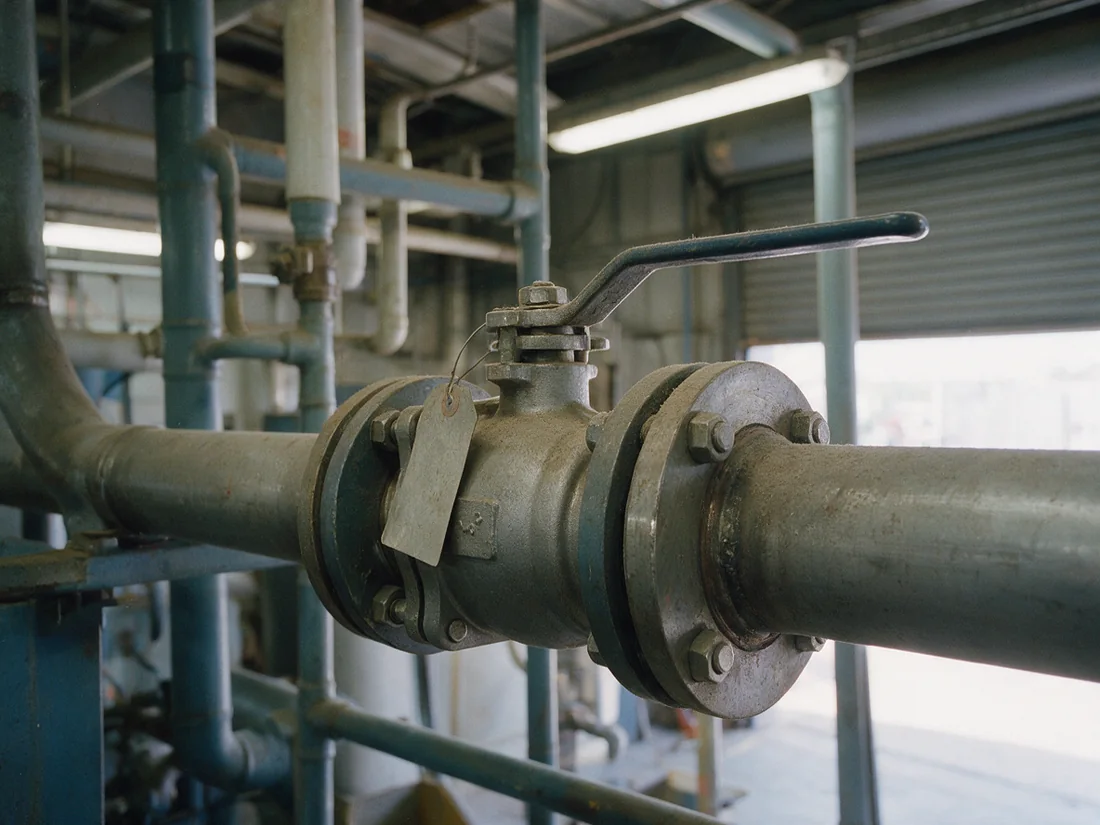
A ball valve rotates a bored sphere between seats — normally resilient seats in soft materials such as PTFE or its reinforced grades. Fully open, a full-bore ball is very nearly as unobstructed as a gate; fully closed, a soft-seated ball gives the tightest routine shutoff of the three. It gets there in a quarter turn, which is why the ball pattern dominates automated service: a compact rotary actuator, a short stroke and a clean open/shut signal, all covered on our actuators and automation page.
Its limits are equally specific. The soft seat sets the temperature ceiling — reinforced PTFE, PEEK or metal-seated constructions extend it, but the seat, not the body, is what you must check against the service temperature. The body cavity traps fluid between the seats, which matters for liquids that expand or for cryogenic and hygienic duties, so cavity-relieved or vented designs exist for a reason. Throttling wears the seat asymmetrically and should be avoided. And that fast quarter turn is itself a hazard on a long liquid line, where slamming a ball shut is a textbook route to water hammer.
05The duty questions that actually decide it
We ask the same short list on every enquiry, and it settles the pattern before anyone opens a price list. Is the valve there to shut, or to set a flow? If any part of the answer is "set a flow", the gate and the ball are out. How often does it move? Twice a year for a maintenance isolation flatters a gate; forty operations a shift demands a quarter turn. What is in the fluid? Clean utility water forgives everything, while fibres, scale or catalyst fines punish soft seats and tight clearances. How tight must shut be? A weep past a maintenance isolation may be acceptable; drop-tight isolation for hot work is not negotiable. How hot does it run, at worst? That question interrogates the seat before it interrogates the body.
If it must shut and stay shut, and head loss matters — gate. If it must hold a rate — globe or a control pattern. If it must move fast, often, or under an actuator — ball. When two of those pull in opposite directions, that is exactly the conversation to have with an engineer rather than a catalogue.
06The selection table
The table below is the compressed version of the four sections above — the one we would sketch on a whiteboard if you were sitting across the desk. Read it down the criterion column that your duty cares about most, not across the row you already prefer.
| Criterion | Gate | Globe | Ball |
|---|---|---|---|
| Primary job | Isolation only | Throttling and regulation | Isolation, fast and tight |
| Motion | Multi-turn, linear wedge | Multi-turn, linear disc | Quarter-turn rotary |
| Pressure drop fully open | Very low — effectively straight bore | High — inherent to the S-path body | Very low if full bore; moderate if reduced bore |
| Part-open operation | Damaging: wire-draws the seat, disc chatters | What it is designed for | Damaging: uneven seat wear |
| Cycling frequency | Occasional — slow to operate | Continuous modulation, but slow to stroke | Frequent — the pattern for duty cycling |
| Shutoff tightness | Good; metal-to-metal, degrades with wear | Good; face-seated | Best in routine service with resilient seats |
| Fluids with solids | Tolerant — clear bore, knife-gate for slurries | Poor — pockets and tight trim | Fair when full bore; fines abrade soft seats |
| Temperature ceiling set by | Body and packing materials | Body, trim and packing | The seat material — check it first |
| Automation | Multi-turn actuator, larger and slower | Linear actuator with real thrust | Compact rotary actuator — simplest to automate |
| Space and weight | Long face-to-face, tall with rising stem | Bulky body, moderate height | Compact, light for the bore |
| Classic failure when misapplied | Used as a throttle — eroded seat, damaged wedge | Oversized — runs near the seat, wears the trim | Slammed shut — water hammer down the line |
07What we see go wrong at the counter
Three mistakes recur often enough to name. The first is throttling with an isolation valve because it was already installed — a gate cracked open to trim a flow will erode its own sealing faces and then fail to shut when it is genuinely needed. The second is choosing on bore price at large diameters, where a butterfly or a reduced-bore ball may be the honest engineering answer and the "cheaper" full-bore gate is simply the wrong tool bought well; we set out that arithmetic in why the cheapest valve usually costs the most. The third is specifying a soft-seated ball against a body temperature rating rather than a seat rating, which works perfectly until the first steam-out.
If you want the two-way version of this comparison in more depth, our gate valve vs ball valve page takes the isolation question on its own. Any term above that is unfamiliar — trim, wire-drawing, full bore, face-to-face — is defined in the glossary.
08From shortlist to enquiry
Once the pattern is settled, four things finish the specification: the body material against the fluid and the environment (compared in valve body materials: WCB, stainless and bronze), the pressure class read against the actual operating temperature, the end connections and face-to-face dimensions checked against the piping spec, and the actuation decided now rather than at commissioning.
- State the job in one line: isolate, throttle or protect.
- Give fluid, operating and upset pressure, and worst-case temperature.
- Say how often the valve operates and how tight shut must be.
- Note the bore, end connection and any space or weight constraint.
- Flag whether it will ever be automated.
Send that and you get a real answer rather than a catalogue page. Most of what we ship against these duties comes from our KITZ line, and where the duty is unusual we don't just sell parts — we sit down with your engineers to make sure they get the right solution. More selection reading sits on our insights index, and the mechanics of quoting are set out in how ordering and technical support work.